We can say it frankly.
The first part of this fantastic article The Archetypes: art form intrigued you so much that you couldn’t wait to read the second part
Discover what the other archetypes are and which contemporary works of art can embody them, making them usable to our attention, our understanding and our urge to learn more and more.
Without further ado, here I present them!

SHADOW
Have you ever heard of Dr. Jekyll and Mr. Hyde? Of your evil or less good counterpart, hidden in the dark? “The Dark Side of the Moon”?
Here, the Shadow is an Archetype that synthesized can mean this. Except that when Jung described it, all these cultural references still didn’t exist. However, there were unconscious applications – but not so much – to the world of culture and universal iconography

It represents the part of us that we don’t want the world to see.
The opposite of the Archetype Persona, in a nutshell.
It is so because it embodies that indissoluble part of us, which we are ashamed of or fear in some way. But which sometimes represents something we use to react.
Indeed, it would be wrong to speak of “wickedness” in it. Because in a very meek and unresponsive person, a healthy aggressive or more leathery side can help. Only it walks behind us, like a shadow. Term that Jung borrowed from Nietzsche.
Attempting to repress this aspect of the archaic personality does not make it disappear, on the contrary; it tends to make us live in constant conflict with it, creating a good portion of neurosis.
Furthermore, Jung further divided the figure of the Shadow into two types: personal and impersonal Shadow.
The first represents the most everyday behaviors within everyone’s reach: frustrations, fears, selfishness, narcissism and common negativity.
The second represents something broader and, without a doubt. more dangerous; something that belongs to all humanity, according to the Jungian mosaic of Collective Unconscious: evil in general, the desire for collective genocide, sociopathy, the total lack of empathy towards men, animals or other and violent psychosis.
A perfect example of the incarnation of this Archetype is the sculpture above by the Thai artist Rook Floro, who manages with a simple but effective talent to represent the Archetype himself, by his own admission.

Egon Schiele represents the ideal artist for the discourse of the double and of the Shadow Archetype: In the work “The Hermits” of 1912, the basic idea is to illustrate two monks in a long black habit walking side by side. In the large dark shape that constitutes their two bodies – a single shape – two heads actually appear to be sprouting.
One has a vivid and feral gaze, the other has empty eyes and resembles that of a puppet. One is young and beardless (a self-portrait of the artist), the other has a beard, a more placid expression and a chaplet on his head.
He even seems to be asleep after a night of revelry, of which the crown represents a residue.
In these characters we have found many references to themes such as Apollonian and Nietzschean Dionysian, to Dostoevsky, and of course to the theme of the Double, which acts as the archetypal father to many of these concepts and cultural contents.
Schiele himself described the setting of this work as “a distressed world in which the two figures arose from the earth in solitude, organically sprouting from the ground“.
Ergo, two distinct souls in one body. A half visible in everyday light and a dark and revealing half (not necessarily evil) but simply different from the one you wanted to show.
Although much appreciated by his collectors and colleagues, Schiele, he was also known through his works often considered obscene, vile, gloomy and contrary to the sparkling taste of the Secessionist Renaissance (as did his friend and mentor Klimt).
In him there was the soul of a painter who wanted to show a certain type of reality, of sensuality and of his personal demons, while leaving the world the person that everyone would have wanted.
But on the canvas, he left his Shadow free to express himself, with also a sort of silent contempt for the bigoted morality of his Austria.
Masterfully summed up in this look:

PS: Speaking about Archetypes surviving to the present day and recreating themselves in our culture, does this remind you of anything …?

LA GRANDE MADRE
“Mother is mother, everytime“
This phrase often returns to everyone’s lips. The meaning is not complex. the mother has a status of sacredness and of unique importance, which transcends what are normal social dynamics.
But … where did this saying come from?
Probably from the fact that the MOTHER has a meaning that goes far beyond the psychological: it is something primordial, an absolute bond not only mother-child but also with the concept of creating, of starting life.
To change the natural order of things.
It is no coincidence that words such as MATERIAL derives from MATER, due to its stong creative connotation.

The Great Mother Archetype described by Jung is rather simple to illustrate, precisely because it has its roots in a larger discourse, existing since the dawn of time.
The Mother Goddess has always existed in all cultures, even the most archaic. Starting from the Greek Gaea that merging with Uranus gave birth to life. The classic model of Mother Earth.
The Babylonian Ti’amat, Ashtoreth for the Phoenicians, Ishtar in the fertile crescent, Astarte for the populations of Semitic culture, in Arabia as Atar, by the Egyptians as Hathor.
These divine mothers all represented the same characteristics, both as power in the collective imagination, and aesthetically in the way of representing them.
Therefore the Archetype represents a type of indelible relationship not only of the child with the physical mother, but also of the community towards the divinity. And when there is no divinity with a series of figures of higher power: the Earth, the Sea, the Moon, even the Church.
Obviously, also considering all the enormous parallel between these archetypal lines and the figure of the Christian Mother, the figure par excellence of Mary who also embodies (in fact) Mother Church.

Caravaggio, “Madonna of Pilgrims”,(particular) 1604/06, Sant’Agostino Church, Rome
The Great Mother represents family tradition, the instinct of protection and the aspect of the goddess of fertility, it contains within itself a protective and welcoming aspect.
This must be followed by a driving force towards separation, in which the parent pushes the child to grow, to differentiate himself from himself.
However, if the mother keeps the child with her, not allowing him to become an autonomous individual, he turns into his negative aspect: it creates a regressive tendency that makes the child remain in a condition of psychic incorporation, making him dependent on her.
From there the Good Mother can become a Bad Mother.
And also of bad mothers, nor is the culture and psychological tradition full…

But we are always talking about Archetypes: art forms.
To describe the Mother Archetype there would be as many eloquent works, beautiful and excellent for the purpose.
We choose one that is more unconventional…

Bourgeois‘s work is affected by the surrealist thrust, but in a much more physical, more symbolic way, but bordering on psychoanalytic discourse. Even more visceral and material, as it is sculptural.
The Maman sculpture (repeated several times and exhibited in various parts of the world) represents a giant female spider, well rooted on the ground, confident and proud.
This enormous totem-object represents in everything the characteristics of a mother for the artist; but for Jung what are the characteristics of the Archetype.
In contrast to a paternal figure, which in his works he tended to destroy, the maternal and female figure is absolutely exalted: strength, greatness (Grance Madre), protection, always being a comfort zone for one’s little ones.
In fact, the spider contains in its belly some eggs made of marble, not only to evoke pregnancy but also of the eternal protection that the mother kingdom offers, of the secure nest that its presence embodies.
Already in the 1960s, the artist had developed her concept of Woman-Home and the refuge it generates.
In an excerpt from an interview released for Tate, Louise Bourgeois states in a very simple way that the spider represents her mother: She was my best friend. Like a spider, my mother was a weaver (…) So, spiders are useful and protective, just like my mother. cit.
That weaver spider is also an association with female crafts related to weaving: working with threads, for Freud, would be an action – a symbol of “penis envy” on the part of women. The creation of works with threads would be associated with the virility of male hair.
ETERNAL CHILD
Peter Pan syndrome
This is usually said when an adult always tends to behave as if inside there was always a naive and enthusiastic figure, spontaneous and without too much desire to take responsibility.
In short, a child.
But this apparently simple Archetype becomes complex in its symbolic stratifications.
The Eternal Child does not only represent lightheartedness and being candid, but also concerns some spontaneous aspects of the character, such as creativity, dispassionate trust, flexibility and the ability to model oneself according to needs, a bit as if it were all a game.
It is not a question of age, but of worldview: The Child is an Archetype that mediates behavior:
The figure of Peter Pan as a cultural reference is quite fitting, as an eternal boy is also devoted to behavior that is sometimes irreverent, playful, heedless of the consequences and of opposition to those who always want to act according to rules and limits.
In mythology Cupid has been mentioned several times as an eternal child, but his image had a decidedly more genuine and altruistic flavor. On the other hand, Hermes, also a winged god messenger of the gods, appears as a puer adolescent more smoky, impertinent and the cause of many troubles and even misunderstandings.
It is no coincidence that all three examples (Cupid, Ermes and Peter Pan) have in common the characteristic of being able to fly.

Parmigianino, Cupid makes the bow, 1535, Kunsthistorisches Museum, Wien
The other side of the coin of this Archetype is precisely his possibility of overcoming the good aspects, to transform himself into a light-hearted and irresponsible child, spiteful and with a tendency to narcisism.
Speaking as always of Archetypes: art forms, let’s talk about the Child transliterated into contemporary art:

The work shown here “Angelus Novus” is one of the lesser known drawings by Paul Klee, the famous Swiss abstract painter.
Although Klee was an abstractionist, in his art there is always a component of recognizability that makes him appealing to the public, who still manages to be involved in his dialectic.
Speaking about this small-format work, a little less dialectic.
The subject represented in itself is difficult: a pseudo-human figure with wings and a very large head, with a smiling and communicative face.
This work belonged for many years to the writer and philosopher Walter Benjamin, who also described it as a sort of portrait of a historical-philosophical concept called “Angel of History”:
It would be a parable about the tragic effects that would be created later due to progress.
But if we leave Benjamin aside and concentrate only on the work itself, we will see that in all of Klee’s works, there is what Claudio Strinati defines as “childish shorthand”.
The hand of a large and mature man who tries to represent a fairytale world away from the eyes of reality. “Art does not represent the visible, it makes visible” cit. and everything becomes possible for an artist. Hence his absolutely enchanted abstractionism.
I would not be wrong, but it does not seem a very dreamy and also naive, candid point of view…
THE TRUE SELF
We have arrived at the latest archetype, my favorite.
The True Self.
It wouldn’t really be the last, but doing them all, believe me, would take a really long time
First of all there is a big difference between the Self and the TRUE SELF: if we can all say that (good or bad) we are present to ourselves, to guarantee the presence of the true Self, we speak of an active con-presence of consciousness and unconsciousness as a whole and represents the totality of the Psyche
Which is practically impossible.
Even just for Freud’s basic idea of the unconscious, the True Self represents something almost unattainable

A Hindu mandala, called “Of the nine deities”: the mandala can represent the completeness and awareness of individuation proposed by Jung
For the Jungian point of view, the True Self was something innate to which it was possible to return: at birth the Self results in its own totality; however, as one grows, a separate Ego consciousness develops, also known as Consciousness.
Growing up develops consciousness (ME) and Self presence, but paradoxically restricts the True Self.
Quoting Paolo Francesco Pieri in his “Jungian Dictionary“, the Self is a symbol of the tendential unity of the psyche. The Self is not an intermediate third of the psyche (as for Freud), but expresses consciousness and unconscious together.
As Archetype, it is central, organizer and its presence – if reached – aims to bring harmony between all the other aspects and between all the other archetypes.
This type of self-realization is modeled both on the historical model of alchemy (in which the steps of the Individuation trace the stages of the achievement of the Great Alchemical Work of Chemical Transmutation); but also a spiritual path, such as reaching Nirvana Buddhist or Hindu world.

There is, as in all Archetypes, also a downside related to this: imagine being overwhelmed by an excessive security towards your complete psyche. Convinced that you can do and achieve everything, especially from yourself.
Do not believe that you could lead to attitudes completely taken to the extreme, such as megalomania, narcissism, a sense of superiority with the real data. Feeling equal to God.
I understand that, as an Archetype, it could be certainly the most complex.
But that makes it really fascinating. Precisely because its references are manifold.
Now, we find its artistic reference, since we are talking about Archetypes: art forms.

I want to be sincere: the choice of this work is based not only on its fil rouge with the multiple and layered characteristics of this archetype, but also on a personal fact.
Because this work remained in my heart when I saw it live. I considered it the highest point of conjunction between idea, material, iconicity, symbolism, cultural references and aesthetic beauty.
It was perfect.
Thousands of things could be said about this work, For the love of God, above all because Damien Hirst himself has had the opportunity to talk about it very often, in many channels dedicated to him.
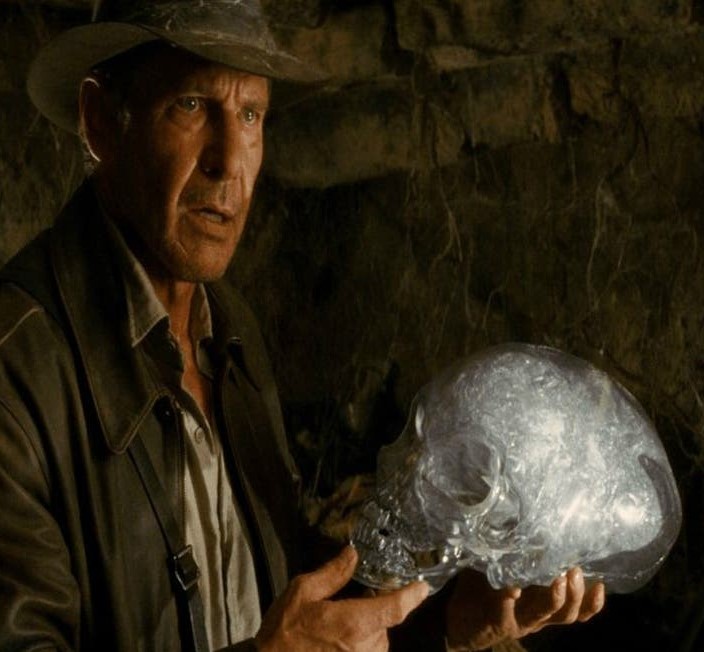
Let’s start by saying that the cultural origin of this human skull covered with platinum and decorated with a pavé of 8,601 diamonds, we can find it in three distinct references (two certain, one alleged):
1• Aztec idols covered with semi-precious stones, of which the artist saw an example at the British Museum
2• the works of the seventeenth century in which the memento mori skulls appeared
3• The Crystal Skull of Indiana Jones (itself inspired by presumed pre-Columbian Mesoamerican artefacts of particular manufacture).
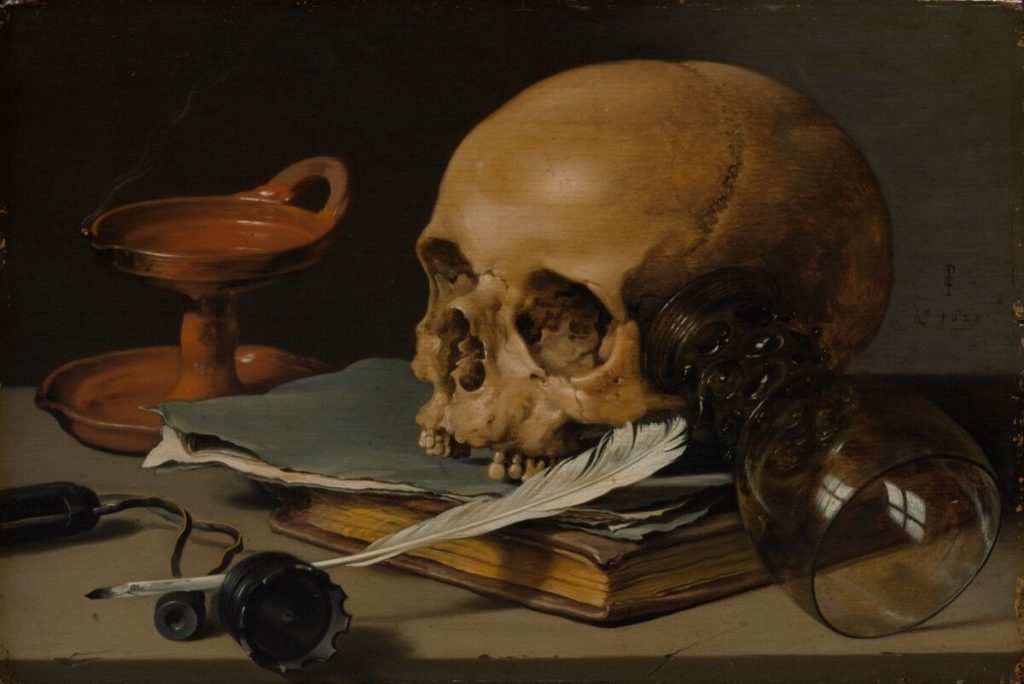
Pieter Claesz, Still Life with Skull and Writing Quills, 1628. Metropolitan Museum of Art, New York
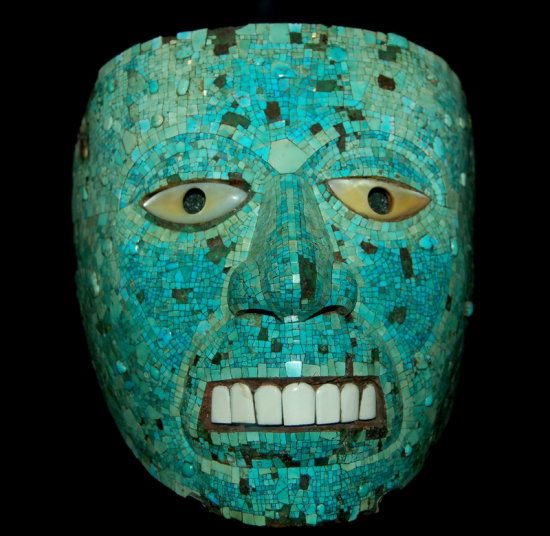
Mask of the idol Xiuhtecuhtli, British Museum, London
Damien Hirst created his idol of our day, imbued with that occult power of which pagan divinities were convinced;
The double meaning in the title refers both to a devotional dimension: (For the love of God) and to a well-known saying that assumes a feeling of refusal, of sarcasm;
(the artist is also known for using a lot of double-edged irony in his works)
(FOR THE LOVE OF GOD! Sounds as “OH MY GOD!!”).
At the same time with one foot in reality and humility, reminding the human being today that he is a being of passage on this Earth.
There is therefore an extraordinary duality, to begin with:
simplicity and eccentricity,
a sense of divinity and a thought of humble acceptance towards death,
a double meaning in the title.
All enclosed in a kind of work of art mixed with something revealing.
The archetype of the True Self represents a state of superiority, a conjunction of knowledge and attributes. Exactly like this one.
While Hirst has done many extraordinary (and all very sober) works over the years, in my opinion, none achieves superiority like this:
the transition from a skull-only awareness to a more complete form.
Even the title, if pronounced in a certain way to a shamanic formula that seems to want to put us in contact with an interior (or divine) dimension of a higher nature.
An artistic nirvana, so to speak.
And to find one more detail:
I do not know the master personally, but I believe that if you do a rundown of all his works, even recent ones. you realize that a tendency to “big” (very big) and grandiose is present.
So, Archetypes: art forms.
I think we’ve done a fair amount of correspondence here. But if you want, there are many Archetypes…
Follow us on our Fcb or Instagram pages to participate in the survey “Which kind of Archetype are you?”
The Blue Drop – Archetypes: art forms (PART TWO)
Black is over