There are many anecdotes about how artistic tendencies were born. By my side, I hope to tell many here…
But I find particularly suitable inaugurating this new blog adventure with one of this.
We must consider anecdotes as good, since sometimes their truthfulness is equal to a legend. But who does not find the legends fascinating with their aura of mystery: “And if it were true ….”
There are many anecdotes about how artistic movements are born
Who says that Impressionism was born in many ways:
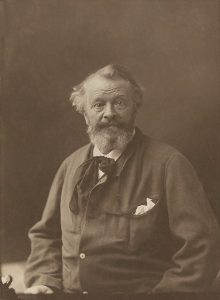
– At the photographer Nadar’s studio, – logistical point of view-. In his atelier in Rue d’Anjou St. Honoré 51, on April 15th, 1874, there was the first exhibition of artists destined to become big under the ranks of Impressionism.
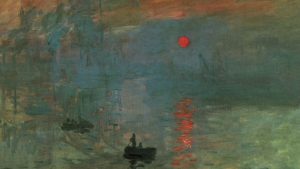
-By nominal point of view: from the famous painting “Impression, soleil levant” by Monet painted in 1872, two years before the prevoius exhibition. It’s also true that “Impressionist” mark was given by critics indicating that these works had only a partial artistic presence of the painter – an impression – and that precisely “everything else” was missing before they could be defined as a paintings.
We will overlook the fact that an impression has a not inconsiderable impact effect, sometimes even more authentic than what a refined and preparated image can give. Those critics had been “hit”, but they couldn’t say …
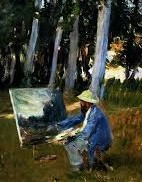
-By commercial point of view: the color in a tube was born! And going outside to paint according to the nature became their hallmark.
-By Historical – artistic point of view: the Realism of Courbet and the Barbizon’s Community, where many of these artists had taken refuge to paint immersed in the bucolic atmosphere.
-And then by narrative point of view, also suggestive one: Pierre Auguste Renoir tells in his famous anecdote: one day one of these artists, forgot the black color, and he used blue one. And Impressionism was born
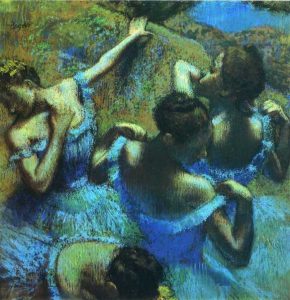
Revolution? Black became a colour less used by Impressionists, because its absence of color made it cold in relation to the thousand shades that blue could offer. Although blue is also cold in the tonal scale, it can be faded and shaded, mixed and tapered; it managed to warm up in its darkness and shine alongside white. He always managed to bring a piece of sky and sea into the various “impressions” of these artists and it transformed even simple figures like peasant women and ballerinas into elegant ladies , where black made them gloomy. Blue became a catalyst for sunrises and sunsets and the basis for shadows and glazes and their nights became unique in any weather.
Many artists and artistic tendency are tied to a single color. I cannot say that the symbol of Impressionism is blue because it would be denigrating the enormity of chromatic variations in this artistic field. But, like Venus, Impressionism was born from several waves, among which there was sure a blue one…
Illustrations :
Camille Pissarro, The Boulevard Montmartre at Night, 1897
Felix Nadar, Self portrait, ca. 1900
Claude Monet, Impression, soleil levant, 1872
John Singer Sargent, Claude Monet Painting by the Edge of a Wood, ca. 1885 (particular)
Edgar Degas, Blue dancers, 1897 ca.