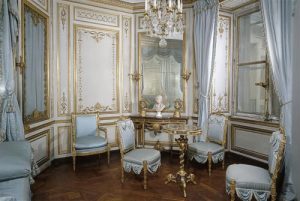
Looking at this work can be two things to catch our attention: the naked woman or the beautiful color of the sky. Although the second is the least important or least “alive” thing of the scene, it is also the detail that most covers the surface of the canvas. It immediately reminded me of the upholstery of some lined room, with that touch of yellowed wear that gives time. It reminded me visiting the still perfectly preserved royal palaces. The cool thing is that Felicien Rops also painted the sky with actual presence into a room of blue satin. Our feeling was undeniable.
It was 1878 when Felicien finished it, a work halfway between an iconographic illustration and a pamphlet on the libertine adventures at the French court. At the time Felicien was a 45-year-old Belgian, attracted by what he himself called “his little intoxication” when talking about the golden vices of Paris. He is a charming, cheerful, ironic man who attends the best of bohemian social life but without the self-destructive propensity towards Modigliani. He lives with two sisters working as tailors, they are both his lovers and have children. The prostitutes she attends are friends, models, muses. It is not a type to paint a naked woman with the intent to denigrate her but to the limit of making fun of the world around her.
The protagonist is a walking blindfolded goddess. However, as Mitzi Green sang, “The Lady is a Tramp” or the Lady is a vagabond (sweetened term …). Although Rops could not know the phrase of the song, the two words that compose it seem destined in an ambiguous, friendly and intelligent way to the dual nature of this figure: a Lady in the milliner sense, for her beautiful shoes, silk stockings, long gloves and jewels. However, for the attitude and other details, such as what is naked, the hypothesis that she may also be a little easy is made valid. In short, a courtesan.
The paradox of these two terms compared has always been fun, as going with a courtesan was real far from easy. It was necessary to be very rich or better yet very powerful, to have weight at court and to guarantee her protection. Then fill it with expensive gifts, welcome and feed all the small courtyard that the Lady attracted around, including the entourage. For their less rigid and more progressive attitude, the courtesans were wonderful patrons, favoring art and culture and enlightened knowledge, more than many crowned heads.The Arts, represented here, are four figures in the frieze of the temple above which the Lady is waving; but they are far from exalted. They are closed, in positions of refusal and denial, abandoned to crying tears and with their faces in their hands.
She is a Lady, but she is not a courtesan.
The plaque reads very clearly Pornocracy: in Greek language porn was in the terms for “prostitute”. Rops, with symbolic elegance and a good dose of irony, creates a trick in which the spectator is invited to guess what the hidden word is.
Pornocracy, the government of prostitutes, an anachronistic Party of Love, in which women of malice walk with their heads held high. But is it the pig to guide the Lady, so lost in her vices that she doesn’t even need to look? Or is her power such that she allows herself to use the pig as her subordinate, as a walking animal? Should be she like a modern sorceress Circe who punishes men for their presumption? The interesting thing is that in Rops’s works (and others will be seen on this blog) the female figure, who is wife, seller, prostitute, dancer, flesh or symbol, is everytime in a position of equality or superiority over the male . The cherubs representing the loves, now past, old and stale of the Lady, are all boys who run away from the now situation in which love no longer exists and in the spoiled and vicious bourgeoisie it is “easy love” to rule. The Lady is triumphant in her pure exhibitionism, she must not be ashamed and can also go around blindfolded, since there is her animal trust to guide her. Walk on the frieze of the temple, not on the staircase together with the philosophers, it has reached the top.
The period in which Rops and his colleagues live and work is an enormously rich period: impressionists, symbolists, verists, bohemians … every single action of their own stems from a strong contrary thrust towards important enemies: the bourgeoisie, the Academy, religion.
Therefore, Arts trampled by the Lady are not intended as denigration of the art of that times or for Rop’s colleagues, but critical of that redundant search for classical perfection that was now stale and bored those who had a symbolic soul or a perception wider. So much so that when it was exhibited in 1886 at the LES XX exhibition (the Belgian equivalent of Independent Artists Salon) it still caused scandal.
There was those who hypothesized that Rops had decided to refer to a treatise by the philosopher and anarchic Proudhon when in 1875 he wrote La Pornocratie ou les femmes dans les temps modernes (women of modern times). Read this way, the picture can also be read in an meaning referring to sexism and to female denigration. You can judge as you like it: but in my opinion, in this fierce head and in her total lack of interesting for the world looking at her (whom with disgusting, whom with regret, whom with desire) you can find a Victory. All the hypocritial pigsty is tied and kept at bay.
She will be also Porn, but the power is in her hands!
Illustrations:
- Felicien Rops, Pornokratès or, La dame au cochon or The woman with pig, 1878, Musée provincial Félicien Rops
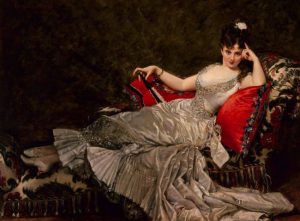
- Charles Carolus-Duran, Portrait of Julia Tahl known as Mademoiselle Alice de Lancey, 1876 – Petit Palais, Musée des Beaux-Arts de la Ville de Paris, Paris