If sensitivity changes with the seasons, I wonder what sensitivity means in the autumn season. And I’m not just talking about how you live it. I’m talking about how it is represented through art forms.
The seasons are a natural fact and although some tend to deny them, they will continue to exist as long as the Earth continues to turn.
There are those who say (with an innate spirit of originality) “that the mid-seasons no longer exist”. In truth, the half seasons exist, only that people are too distracted, demanding and insatiable to notice.
Each of us perceives the seasons differently. But in the collective ideal there are elements that are the same for everyone, others that are even too obvious to deny. For this reason, the seasons can be described with a series of keywords, commonly accepted by all.
Words for free association.
Winter: snow, cold, Christmas, scarf, coat, white.
Summer: hot, sea, vacation, friends, ice cream, watermelon, water, yellow.
Spring: flowers, rose, meadow, nature, outing, greenery, Easter.
By the way, along the history of art, representing the seasons was a typical thing and also quite recognizable in the various iconographies. Which means that since man has existed and has been able to provide his own interpretation of the concept of the season, these have been identified with specific characteristics.
Just think of the wonderful figures painted by Giuseppe Arcimboldo, who even managed to sublimate an entire portrait and make it eloquent and suggestive.
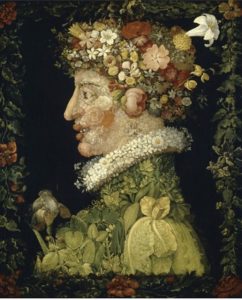
“Spring“
1573
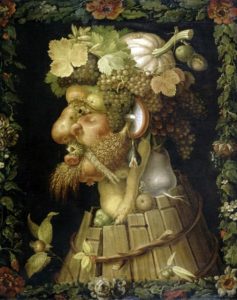
“Autumn“
1573
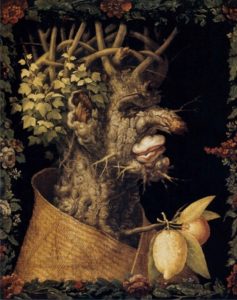
1573
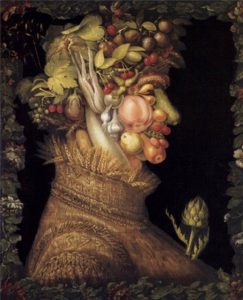
“Summer”
1573
This is because, on a perceptual and psychological level, the seasons are much more than periods linked to the current month.
They are moods with very specific meanings; they are complex systems of suggestion on which the stylistic choices of many things are based:
From the simplest things, like the type of colors we use to dress, to the type of music we listen to, the type of food we consume.
To the more complex ones, such as the inspiration and suggestion that led many artists to paint
Or even better, to choose to represent one season rather than another.
And this is what this article will deal with: how a particular season affects the perceptual and then the emotional system and how this influence can lead to the creation of works of sublime beauty.
In particular, thanks to the deepest, most multifaceted and kaleidoscopic of the seasons.
The Autumn

Let’s start by saying that there is a very strong correlation between a season and the impact it has on our emotional and psychological system. Hence the equation “season – perception – artistic inspiration”
But why autumn? In this case it is an absolutely personal choice: I believe that there are no periods like this in which it is possible to enjoy a synthesis of natural beauty and at the same time of lucid and gentle depth of the things around us. The arrival of the first fresh, but also the resumption of activities, makes us return to a more intimate dimension. We feel the need for warmth more – both thermal and human – but also to create a kind of comforting dimension. Through things like the food, the music, the atmosphere.
We find that pleasure in staying at home, even alone, we go in search of what I call “the soft emotional”.
Being in contact with ourselves inevitably makes us more sensitive: the desire to be in a few or alone triggers in us a need to interface with ourselves and inevitably come to terms with our own thoughts and with our ego.
But this makes us more exposed, inwardly speaking. Many are afraid of being alone with their depths and having time to reflect. This attitude is compensated for in many ways, for example by seeking more company.
In the psychological field, this change of mood linked to the change of a season was analyzed with the entry Seasonal Affective Disorder (SAD).
It is defined as a real form of depression, explained by the lower presence of sunlight in relation to neurotransmitters such as serotonin and melatonin.

SAD seen in this way, however, does not explain how the same symptoms appear even when spring and summer arrive. The so-called “Summertime Sadness”, which many explain through exactly opposite reasons: the heat that makes us weak, the closure of many activities that makes the general atmosphere slow down. And also the sense of frustration at not being able to go on vacation, since summer is synonymous with that for status (and mental iconography).
In short, for many schools of thought it is normal to be anxious and melancholy all year round.

In my opinion, autumn is instead a time when neither the cold nor the dark are such as to justify the sadness.
Autumn is a season in which the sun is still warm and with a summer brightness that nevertheless blends with the chromatic changes of the Earth. Perceptually, it is nature that changes, not the sun.

All this (influences, predefined correspondences, moods, mood changes, suggestions, traditions, mental and artistic iconography, attitudes, personalities) has given life to a series of spectacular works in which autumn turns into a protagonist or a scenography, in an intent of tactile suggestion or mental influence.
Take for example the two works by Edward Munch shown above. Time apart 12 years, they represent two different moments of autumn. Rain and a placid afternoon in a forest.
Although the artist is the same (with everything related to his poetics and his emotional heritage always present) there is an immense difference between the two works. The frenzy of a driving rain and stirred by the wind is combined with the scene of the city and with the image of people at the mercy. These same brushstrokes are quite fitting, in a neurotic burst, reminiscent of a Monet even if here the impressionist charge instead of being naturalistic and rather mental and perceptive.
On the other hand, the scene of the forest is quite different. Here, the brushstrokes seem to be given with the wad and the hazy softness of the scene undoubtedly relaxes the eye. Even that of the painter.
The difference – besides the intent – lies in the theater in which the scene takes place. In the city, autumn is a frenzied manifestation of vibrant anxiety, in which people do not see each other’s faces and each of them is an impersonal entity. In contact with nature, the season softens and its characteristics change. It is no longer the hatred of cold and damp but the warmth of reds and oranges that marry with the tranquility of two characters walking near a lake.
Let’s go back for a moment to the symbol words that really help describe this season. If you try to imagine how you would describe autumn, there will be things like:
Wood – Leaf – Pumpkin – Cinnamon – Forest – Hot chocolate – Rain- Tree – Orange color – Brown color – Cold– Chestnut – Red Wine – Grape – Figues – Lethargy – Umbrella – Mushroom- Harvest –
And suggestions as :

Among these words, some are linked to a portion of our imagination destined for the sensory sphere and, more specifically, to that sphere that influences thought with the inferential idea of perceiving autumn in that way and the other seasons in another way.
Of these elements, perhaps one of the strongest is that linked to Nature.
Because it is in it that the changes of the season can be touched the most. Contact with our first sense of perceptual processing (the senses) is the most immediate thing to notice. Especially in places where there are many trees, such as woods, forests, parks and gardens.
Autumn also comes to the sea, there is no doubt. However this is a context that in our collective imagination does not possess the chromatic, visual and perceptive requirements to give body to autumn.
Although there are many people to whom the sea influences and inspires aspects such as melancholy and loneliness – because of its isolating vastness – what is most striking is linked to the chromatic impact that acts on our limbic system, which in turn it binds to conscious and unconscious associations to which they educate us since childhood.
The autumn woods – the arrival of cold weather – the restart of the school – the decrease in outdoor activities.

This rich interconnection occurs less in a context like that of the sea, where colors are less variegated and variable.
Above all, the environment of the forest or park is the focal point that attracts the suggestion of the season and inspires everyone. People, dreamers and artists.
There is an almost indissoluble equation between this state of mind and the type of works that have autumn as their theme, which inevitably carry within themselves some communal, almost iconographic, artistic characteristics.
If we also compare three works:
1• the first from 1893 belonging to Russian realism, by Grigoriy Myasoyedov entitled “Autumn Morning” (above)
2• the second entitled “Frederiksborg Castle from medium distance” from 1837-38 by the Danish landscape architect Christen Købke (the first below)
3• and the third one by the Austrian artist Olga Wisinger-Florian entitled “Falling Leaves” from around 1900. , which represented his country in the Impressionist current. (the second below)


What do we observe?
Although the intentions, styles, schools and countries were very different, we find that these works (as well as Munch’s works) all have a very close relationship with Nature: the forest, the trees are the absolute rulers of the scene; sometimes the colors mix together to create that unique mixture of shades and the painter’s eye is not focused on a detail but on the whole.
This is because – let’s take note – compared to summer and spring scenes, where they try to hit you with the freshness and details of various blooming flowers, here nature is undergoing a sort of fascinating and melancholy decline, which pushes you on one side to look but on the other hand to imitate it, going to enclose you in that “soft emotional” that will accompany the months to come.
Autumn in the works is extraordinarily evocative. Compared to summer representations – spring (where nature triumphs) or winter (where the prevarication of silence or solitude makes the image rather muffled) in these works it is as if the protagonists were admitted, but a rather small number.

Therefore, a rather recurring detail in almost all the works related to autumn, even if surrounded by different intentions and styles, is the absolutely rarefied presentation of characters in these works
Paintings that have autumn as their theme have very few characters.
Look at the images presented so far: two, three human figures in all for each work.
Except for Munch and the city scene, but behind that choice, I believe there was an intention to show figures at the mercy of relentless nature, a bit like the authors of Sturm Und Drang
Do you say that the authors have agreed? Or is it precisely the influence of this atmosphere that favors the explosion of naturalistic and atmospheric data to the detriment of the human one? If what psychologists say is right, namely that a season can undoubtedly affect our mood and our point of view, autumn requires solitude, melancholy, emotionality, silence, a warmer and more muffled dimension, in preparation for the long dark. and in the cold that awaits us.
We can show some other wonderful examples:


As can be seen from the numerous examples, the season is thriving, hot and intriguing in many ways. But few people. In Brendekilde’s silky painting, “Wooded Path in Autumn“, a lady seated on the bench looks down the lane to see two people approaching. The loneliness of a perfect autumn glimpse is about to be cut short. And even there, however, few people.
It is a wonderful as well as explainable consequence of the fact that this season in particular lives on a double suggestion:
it holds a unique warmth and chromaticity, far from sad. Painters feed on which, as can be seen from the confusing way of combining autumnal shades, not only exclusive to the Impressionists.
But at the same time it gives off a feeling of desire for intimacy. A perceptive charge that leads to reflection and to wanting to close oneself in a dimension that is only ours. It will be for the first cold, for the first dark, for the awareness that summer is over but that it is not winter yet (even if it is coming).
It is a hybrid

If you agree with what the SAD says, in this case autumn and its atmosphere – also pictorial – constitute a creative response to this double activation
warmth with a push towards greater loneliness
If we look at Daniel Garber’s work just above, “Shadows” we observe that the topic that the painter wants to suggest to the viewer is related to the trees and even to their majestic presence that stands out with the shadows on the house. The only human character is at work cutting wood and is even dominated by one of these shadows.
Nature is present in a gentle way but firmly rooted in its presence, stronger than that of man, who also works in function of it.
Those of you who saw this work were not impressed by the color, but as a perception they felt the cold of the day, of the nearby river, of the light gray of the house. And maybe they didn’t think about how inside there could be a lit fireplace (the house has a chimney) and how much inside there could be the smell of wood and chestnuts.
And from there we return to our starting equation: “season – perception – artistic inspiration”
In addition to talking about perception and inspiration in recreating a realistic natural scene or landscape, many artists have also harnessed this impact to create scenes of absolute magic.

Into the Hishida Shunsō landscape there is a magic atmosphere, that evaporates with the fog.

Even in the case of Prouvé’s Autumn Vision (one of the students-founders of Nancy School) the magical part is not given so much by the characters or by the setting: when the atmosphere of impalpable mystery and the minimal presence of characters wandering in the fog.
Between us, a sun-kissed beach or a beautiful flowery meadow wouldn’t work the same way if we were to tell a mysterious story or a legend.
The paradigm of the “mystery” is articulated precisely according to a scenario where:
1 • mixed colors do not leave the viewer the clarity of understanding what they see
2 • the human figures (which unconsciously can give security) are few
3 • the view is reduced
4 • nature wins over the elements of civilization
5 • the chromatic sphere, even if warm, manages to transmit sensations that make us look for “the soft emotional”
To conclude this digression, on the psycho-emotional suggestion of this particular season and on the way to represent it in painting, a sentence by Stanley Horowitz.
Which somehow can sum up the gist of our article:
Winter is an etching
Spring is a watercolor
Summer is an oil painting
Fall is a mosaic of them all.