


Welcome back my dearest lover of actual speeches
Let’s resume our journey in the double track of viruses and art, second part. Always in the style of The Blue Drop, with the drop of ink and color.
Last time we saw how disease was a means of admonishing religion, affirming and confirming the value of the power of the Old and New Testament stories, to tell the hagiographies of the Saints and the stories of the Church. Therefore used as a way to say something else, something symbolic or allegorical.
Let us now see some examples of the disease always used as an allegory in some very pagan scenes.
We can rest again in the late medieval area (fifteenth and sixteenth centuries) and from Holland to Belgium, up to Italy and Spain, Hyeronimus Bosch is a court painter and beyond. His genius and the incredible beauty of his works derive in particular from one thing: from his ability to represent an indefinite number of tiny details representing unreal things, heavenly and daring scenes. Those hidden details are the language through which he built what he meant and also what he didn’t want.

In the last years of the 1400s he created a truly curious work, in which the theme is precisely the treatment of the disease, in his own way and according to the canons of the time. “Cutting the Stone“: hospital scene, but in the open air. A man with a real not convinced face is letting they drill to let out “the stone of madness” from his skull. Truly, flowers appear from there and on the table.
In the medieval collective imagination, this system was the only way to cure mental illness, in which not only the mad but also the foolish and the naive were included. KEYE in the archaic Dutch language is stone but also a bulb and this would explain why the artist represented a flower. The disease in this case is mental and the picture takes you back to a famous story in which a naive person, believing himself to be in the hands of a surgeon, is duped by the title and the clothes.
This doctor, as well as the assistants cleverly dressed in clerical clothes, are in truth cheaters, perhaps even drunkards (for the presence of the tavern mug). The nun with the white veil has a book on her head, while the surgeon has a funnel. In the first case, the metaphor of the book is that the weight of knowledge makes the appearance authoritative only, since the obtuseness of the clerical dogmas imposed was reproached. The funnel, on the other hand, is a symbol of stupidity and of those who obtain knowledge and competence by “swallowing without chewing” with study and effort.
In this case, both illness and treatment are allegories of a condition of folly, for those who rely on false therapies; but also pretends to be a healer to deceive people and that through persuasion and collective belief (a bit like psychosis now …) and through this they get devotion and faith. Bosch blamed both figures. The image of the old woman was also interpreted as the madness that together with the friar (the belief in a negative sense) went to create a complete message of the total lack of judgment of an unwise person.
Similarly, we already saw disease as allegory. From the hand of the master Bronzino, who uses an old screaming figure with an unhealthy appereance to represent syphilis, in close opposition with the love that is the main cause. This, in the work “Allegory of the Triumph of Venus and Cupid“

In fact, after the biblical leprosy and the medieval plague, a new great protagonist became coveted by the artists: syphilis or French disease.
Illness with bad consequences, known since the fifteenth century, which became famous in particular for two reasons, one of which is purely medical-scientific: it is in fact a disease that manages to affect many aspects of health, from the skin to the immune system to the neurological one , with consequences also on the patient’s psychological state. The other reason is linked to the moral (and moralistic) dimension of how the disease was transmitted and in which environments it was more possible to take it. Brothels, houses of tolerance, occasional visits, as a sexual disease.
There were indeed other avenues of contagion, but the collective imagination had already traced its designs. It was tied to everything that was outside the sanctity and lawfulness of marriage and the rules of life in keeping with society. Curiously, syphilis had much more social than religious implication, as anyone could take it because anyone could have intercourse. So everyone was afraid of it. Having siphilis meant being held up as “fornicators”, people of dubious morality, even if perhaps a person had the misfortune of being in an unclean toilet. It didn’t mean just getting sick, but also losing home and family, maybe work. It was not like tuberculosis which – it was thought – was at the discretion of those who were in unhealthy breathing environments. In this, the diseases are very democratic.

In the eighteenth century it could be a merry company of modern marriages. The English painter William Hogart was an excellent master of the contemporary social representation of his time, with a vein of extraordinary satire. His story cycles are intelligent and fun, with many details that fueled the continuous double sense. In representing the story of a combined and unhappy marriage, the series “Marriage -a-La Mode” of 1743-45, Hogart also inserts venereal disease.
In one of these paintings , “Téte à téte“, the two spouses can be seen: it is lunchtime and the lady stretches sleepily with the face of someone who has done something during the night. The groom, absent and tired, ignores his wife while the little dog pulls a night cap out of his pocket. The wife doesn’t care. On his neck, a dark spot dominates, symbol of a skin disease that leads to a venereal infection.

The ways in which the disease was represented (allegory, warning, devotion, study and news) certainly did not disappear. What changed was the type of disease, who took it, the way it was perceived and the relationship that artists had in representing it.
Let’s say that from a psychological point of view, the abstract entity of the disease was something that could be used as a banner, as a “small” to represent the big. Later, it moved on to a sort of “companion” or cause, but in any case no longer a small or supernatural presence, but something more current, sanguine and real, which could constitute an entity with which to live. It could have been something evil and mysterious to be inspired by to describe a turbid and romantic, dramatic and fascinating world.
Tuberculosis, syphilis and cholera were the undisputed protagonists of paintings, stories, novels, plays. They were the enemy to fight, the antagonist to be defeated, no longer the devil or heresy, but being born with the “misfortune” of being a man.
For example: In the following illustration, Honoré Daumier places himself halfway between the artist and the news illustrator and shows the city of Paris in his own way in a cholera epidemic in the first half of the 1800s. The most striking thing (the center of the scene ) is the dead man lying on the ground in the doorway of a house. The woman cannot have seen it, but ignores it. Even the dog passes by without interest. Now, Daumier was not famous for his delicacy in dealing with the issues of daily life, but in this case – unfortunately – it is to be thought that the component of indifference was in common use in that context. However, documentation could occur in other ways. Here there is a clear dramatic intent that goes beyond showing. And this is because Daumier was an avid critic of the contemporary society of his time..

Then, cleverly, he takes a situation of illness and current affairs and transforms it into a work that takes sensitivity. It places the observer from a more involved point of view and at the same time induces him to see his point of view. As a society careless and resigned to selfishness, sometimes resulting from well-being, sometimes from the instinct of (one’s own) survival. That is the man, there’s nothing to do.
In any case, the artist puts himself in this scene, he does not limit himself to being the commissioned artist.
Also in George John Pinwell’s 1866 engraving below, it eloquently shows how the danger of cholera was hidden above all in the water. Death itself “serves” unhealthy beverage to its patrons. Although the message is crude, it is undeniable that there is a kind of irony in showing death in this way. Simplicity, so that the message penetrates and making everything more true. Relative of modern advertising.

Even the fact that death was represented as a skeleton that walks, interacts and even dresses like the members of society, attests to its more “papal” value: less courtly, solemn dramatic. Death and disease are part of everyday life and we must live with it.
To return to syphilis, in his case this actualization even went so far as to create his own human form. A thin woman, with a greenish complexion, disheveled hair, bare shoulders, perhaps not very young. We will overlook the fact that the figure may slightly remember a woman of unseemly customs, who according to society were the same unters of the evil of syphilis. As if to forcefully associate them with the disease. In other more modern representations, the 1930s and 1940s took other forms, even that of a little girl. But the fact remains that apparently syphilis must be a woman.
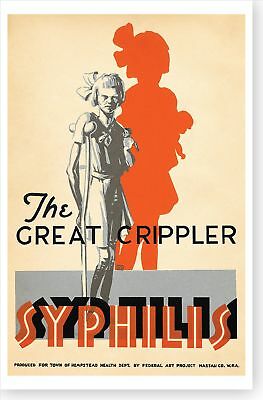
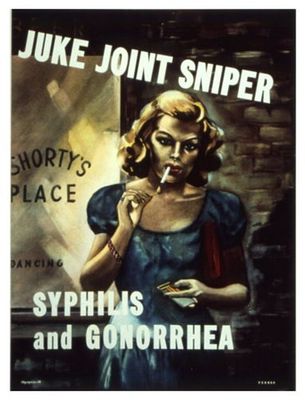
Thanks to the particular environments in which it was thought to spread, it also became a synonym of unruly life, therefore for many, fascinating, worthy of being written and documented, of being painted. In the bohemian environments of the 1800s, prostitutes and dancers became synonymous with this possibility.
We observe the superb portrait that Toulouse-Lautrec makes of “A medical inspection in Rue des Moulins” in 1894. The inspected are women from Pigalle or from the Moulin Rouge or some other place; obedient, they do the inspection all together, in a row. They are already undressed, without particular modesty and with the expression of those who can’t wait for the time to end. They are not too young, not particularly graceful. The blonde has something rude with a bowed posture, gnarled shoulders and a double chin of the past years. Here the disease is not physically present. There are no sick people and there is no drama.

The genius – perhaps involuntary at the time – of Toulouse is that without inserting symbols or references, the words in the title “inspection” “medical” and the figure of two women holding up the petticoat preparing to show the intimate area are enough to open the imagination to the reality of syphilis and all the concepts that the word brought with it: brothel, underworld, little cleaning, customers, red, dark alleys, bubbles on the face, madness. Try to think of the word “syphilis” and tell me if these terms don’t suggest something.
Free association art. As Freud encouraged.
Of course, syphilis was not the only “love” disease present, the sample was wide: there was already gonorrhea, chlamydia, hepatitis. Although they were not as well known and curable. Another great protagonist, tuberculosis, we will see it in the next chapter.
We have seen that they represented a turning point in the way of representing the disease, with irony and realism, but in any case with an active presence in daily life and they also constituted significant social implications. Family, home, friends, work: being a patient of this type made it more than a clinical case. He stuck a precise tag, like the lepers of the Old Testament.
Richard Tennant Cooper, an English painter born in 1885, active throughout the first half of the 1900s, painted the work “Syphilis” in 1912, the description of which is very eloquent: a desperate man probably in having just discovered his infection. Beside her is a beautiful half-naked woman, made up and dressed like a world woman; his unreal figure is floating in the impalpability of a transparent coat. In the windy effect of the cloak comes the old and wounded woman who touches the man. She was hidden trough the folds of pleasure. And now she takes the man. On the table, a bouquet of red flowers that recall the vigor and joy of a healthy life and a bottle that indicates partying. The women grin. The life of that man is destroyed.

This painter was often associated with phantasmagoric and supernatural images, with a constant vein of mystery and tending to the dramatic, most likely inspired by the symbolist research of that period. Here the disease is certainly used with dramatic tones, but always with an image very close to the real life sphere. The party, the jewels, the wine: an allegory here too, but very easy to interpret, unlike the Old Lady by Bronzino.
Next and final chapter, in a few days. Viruses and art, in the manner of The Blue Drop. If you see an old grinning in the room, who is not your grandmother, think back to your last acquaintances…


