Last chapter of this journey, Viruses and Art
The Terrible Two
It must to be only one article, as I have read many these days, on the same topic: “diseases and art”, “the virus and the paintings”, “the pandemic in the history of art” etc …
But I pride myself on being able to do my job. And that’s why I tried not to leave too many viruses uncovered.
It’s time to speak about the Terrible Two
Terrible not because they are worse than the “sisters” who preceded them, indeed.
But just because for a fact of historical reality, it was possible to experience them more closely, to hear about them every day and to have witnessed firsthand their impact on life and art.
Let’s start by talking about the Human Immunodeficiency Virus that broke out in the early 1980s on the American scene

“Gay Related Cancer” was initially called, the perfect formula: in just two words you evoked fear and disgust, the idea that “cancer” and “gay” were a single concept that fed each other, as the symbol of Infinity. A unique idea that moves on its own motion. This happens when so many people reason with one head, one thought.
The virus was immediately and conveniently associated with homosexuals, only because its type of contagiousness was facilitated by less protected and freer sexual behavior. At that time, promiscuity, not only gay, was seen as a revolution and an attitude of liberation after centuries of struggle and repression. The compulsion became love in the sunlight and the attendance of many partners was perfectly accepted without sentimental implications.
We have seen on this journey that every disease has always been given a social label, always very encouraging:
leprosy: sinner against God
cholera: poor
syphilis: prostitute-goer
tuberculosis: romantic and self-destructive artist
HIV: homosexual and/or promiscuos
Yet, as I always say, diseases are very democratic, much more than men. But they are perfect for creating social categories, even where these do not exist.
The “deranged” environment of HIV detractors also included many artists, of course. If the disease became a way for non-gays to label, to marginalize and to curse gays, on the other hand it also became a current, sensitive and very intriguing topic.
The extreme rawness and the black sweetness of David Wojnarowicz touched me a lot. He treated the topic both because AIDS took away the love of his life and his mentor, Peter Hujar, and because he himself was infected and died of it.
There is a huge difference between those who choose to talk about it externally and those who does it because he/she’s impressed by it or succeed a loved one.
If the works of Peter Hujar were black and white photos that described the spiritual, damned and iconic center of New York in the 70s and 80s, the works of David Wojnarowicz were a riot of various mediums. Painting, stencil, collage, but also writing and photography. His masterpieces were also and above all on paper. The book “Close to the Knives: A Memoir of Disintegration” represents his autobiography and his spiritual testament, from his experiences as a street boy until the advent of AIDS in America, among the people and among those close to him.

In the 1987 work “Death of American Spirituality“, David describes very broadly, very broad concepts but also fine thoughts and detailed opinions. “American spirituality” is a spirituality of consumption and profit. It is based on religion but also on edible divinities, seen on television or on the glossy pages of magazines. AIDS brought down some of these myths, which was intolerable for America. The cowboy who falls from the horse and descends towards the maelstrom eddy can be referred to Rock Hudson, the famous Hollywood star symbol of virility, authentic beauty and American robustness, idolized by women and revered by men.
The news of his death for AIDS and his homosexuality was the fall of a god. So too the buffaloes, an idealization of American strength and history, which David also used in another famous photo, as an image of a country full of masks destined to fall because of “gay related cancer”.
Inextricably, the awareness of AIDS to the world was also a cultural opening of and to the gay world: it meant showing on, surviving the next day, not infecting others but also being held up as a greaser. For this reason, the works of art linked to this virus were powerful and effective. But at the same time they were crude and controversial, often aimed at accusing the outside world of indifference and cruelty. It was as if only in the limited environment this art could be understood. The rest of the world was blind, careless and hypocritical, he didn’t care that these people died.
Among the most famous, we cannot quote Keith Haring and his comic, coloured and caustic style.
He was an artist, draftsman, cartoonist: his style was the pop evolution of the idols of Andy Warhol, designed with a simple, unmistakable and witty style. His work was to describe the world and himself and not take himself too seriously. When AIDS broke out, however, he was on the front lines.
Although he was a follower of free sex, he used his art to praise safe sex and prevention (a word that at the beginning, the entire gay community did not want to hear) and how this disease was to be fought together. His “characters” were,in fact, under the banner of peace and brotherly love. The last work done before he died, “Tuttomondo” (All the world), is a hymn to brotherhood, peace and love without borders and without colors. Through the heads and bodies of his “little men” a chain is created destined to unite all the elements, as Haring hoped, knowing that he was also ill.

There are works explicitly dedicated to the virus, many of which are named “Untitled“, from the second half of the 1980s.

In many of these, the real “organ” of the matter is the male organ: it acts as a rope that drags the various men around the works, connecting them with other men and with other characters: it holds them together like a cord umbilical, summarizing what was the true link between many relationships of that period: the pleasure of enjoying the body and freedom. Haring describes cheerful men who let themselves be dominated by their pleasure – he first – very often tangling the characters in bold scenes and funny positions; the representing the joy of being together and brotherly union, or the jump in hellish circles where they are seduced by devils and creatures embedded in animals.

A particular “Untitled” of 1985 puts at the center of the composition, as the arrival and departure of all ties, whether they are legs, arms or members, a human face boiled and disintegrating. The red X holds the focal point where the eye falls and all the creatures around the face try to run away from it. Even if nobody admitted or admits it, there is a good chance that that face is the face of the disease, to which everyone is linked and from whom everyone tries to escape. Which also makes angels cry.
As already mentioned, this type of art was also used to create an unbridled sensitivity to the problem, even if in a certain sense it helped to create the gap between the sick and healthy that already at the beginning public opinion had created. The works of Hering and Wojnarowicz, although focused on the same subjects, fought with opposite styles.
When the problem was finally of interest to heterosexuals and it could no longer be denied that it existed, many artists of the “opposing team” began to show the problem, also because AIDS (which had now changed its name) was also linked to the theme of drug addiction.
In the first article of Viruses and Art, we made a very clear distinction on what were the three macro areas for which artists represented diseases: news, religion, scientific study.
Only later did the artists get into the work and begin to describe from their emotional point of view, showing compassion, fear and often showing their own illness. With AIDS, almost the opposite occurred: we began by bringing out what we had inside, in the most sincere and disturbing way possible, then moving towards an art with demonstrative intentions for the general audience.
An example of this are the photos taken by photographer Therese Frare to activist David Kirby in his last hours of life. The “famous photo that changed the face of AIDS” became so famous thanks to a famous advertising campaign; but its symbolic value and reporting cuts cannot be denied. An external eye who was asked, very simply, to use the commercial value of the photo to make it an image and collective thought.

Completely different was the eye of Nancy Goldin, known in the art world as Nan. Her work on the world of AIDS patients was a work of beauty and personal interpretation, both his and the photographed. It was perhaps the artist who at the same time managed to be in there and to show with a realistic but not documentary eye. The people involved in the shots were all direct knowledge of the photographer. Among his friends were Peter Hujar, David Wojnarowicz, the artist Vittorio Scarpati and his wife Cookie Müeller: her intent was neither to show their sufferings, nor to label them, nor to pity them.
The artist argued that you could not photograph a person without knowing it and that you could not establish an identity without actually seeing what you had in front of you and revealing something more. Her way of photographing was considered liberating towards what was the true physical, aesthetic and sexual identity.
For this reason, the work on his friends, who were sick or artists or simple free spirits, can be considered a step forward for the style of representation of this terrible disease. They are never single photos, they are groups. As if according to her, an individual could not be represented without the others, without a family or without the people with whom he interacts and for whom he chooses to be himself or someone else. Because AIDS does not only concern the patient, but also those who look after him and those who love him.
Her characters are free, charming, brave, made up, colorful, very glamorous. Nan photographed them while laughing, crying, beating each other, loving each other, drinking, celebrating, while they were in bed (famous for the cover of his exhibition – masterpiece, “The Ballad of sexual Dependency“, in which we see the artist and her companion in their room).

Whether it was about sex, friendship or illness, sensitive images remained that portrayed people in their moments of greatest fragility, which could coincide with the moments of greatest beauty.
But above all, we tried and still try today, as Nan Goldin did, to insert the idea of this type of disease in a context where the patient is not alone. But man always manages to overturn his cards. For many, “not being alone” becomes “They are among us”.
I will always remember the phrase of an Italian spot on HIV awareness and prevention, in the 90s:
“Love with your whole body, including your head”
Let’s get to the current pandemic. To the Virus of 2020, sad year, fatal year. The Terrible Two
To Manzoni’s new plague, to the Apocalypse, to the new “Spanish” flu.
To the terrible, horrific Covid-19.

Now, we’re here to write about Viruses and Art, I think it’s clear now. So I will do my best to talk about that and not what I think of this pandemic. Especially how most people tend to deal with it, psychologically speaking. You may not like my point of view.
When the virus exploded, and slowly approached us, the main theme was basically this:
the hospital situation and the medical struggle; the cure that was not there and government aid for the health crisis. We looked at hospitals on how they began to monitor the sick and control the alleged ones.
Among the first works, some comic strips by Milo Manara came out in honor of doctors, nurses, health workers and workers of the basic services. He designed them as frontline superheroes to try to stem the problem. A light and optimistic way, very colorful, to show what were the main pillars in managing the situation.

In several interviews, the master Manara attributes to the art, at this moment, a softening, descriptive and comforting role. It cannot help in the strict sense, but it can offer a detached and positive eye, it helps the imagination, the heart and the mood.
Banksy, the mysterious super hero of the art world, naturally could not help but make his own contribution. Like Manara, with delightful simplicity, he creates “Game Changer” in which a child is portrayed choosing among the various super heroes, the nurse instead of Batman or Spiderman. The irony – which never fails – also lies in the subtle criticism between those who are the real heroes and the “puppets”.

Then, the quarantine began
And there the world arose. Since the same word “QUARANTINE” has sounded like something close to the most terrible patients, at a level of contagiousness never seen. It made us think of the desertification of cities, of disastrous films, of the sick who walk on the streets and who infect simply by touching with a finger. This made us perceive the media world, as if the end of the world were taking place. When the word “lockdown” was heard for the first time on March 13th, scenes such as raids on the supermarket or people frantically escaping from the places of infection were witnessed. There was an outbreak of reactance, the psychological tendency to do exactly the opposite of what is asked, as explained in the dedicated article.
It was there that the artistic world began to describe the new world in which we found ourselves living. It seems necessary but also inevitable, if it is true that art is the daughter of its time. And this is the time of Covid-19
A world of faces covered with masks, with hands kept at a safe distance. From going out cautiously as in wartime to securing primary things.
We try to make a simple reflection, otherwise the discussion will become immense: art has always been the true reflection of life. It reflects and represents all the elements of current affairs as they are experienced. Also from the past, but above all from the present.
We have seen in chapters 1, 2 and 3 of Viruses and Art that in every age, diseases were part of that reality. And depending on what the needs were and the styles were represented.
Today, Covid-19 has found infinitely fertile ground to be represented. Not only because such a reality had never been seen in about a century. And nobody was humanly prepared to face it. But because it was ideal as a topic to be discussed.
The most difficult thing about talking about this period compared to the others, is the incredible multitude of facets that pervades it. Living the art of this moment means living the virus not only as a “fact” but also as a philosophical, social, anthropological, not to say political and economic implication, even if we do not deal with this. Of course, art relishes the opportunity
Photographers have documented deserted cities: beautiful images, in which man fails, as in a photomontage, leaving urban landscapes as wonderful monuments free to breathe.

Big gap between the multitude of people who share my point of view and those who see only a ghostly scene.
Street art is one of the most evident manifestations of dialogue between viruses and art, as the city has proven to be the symbolic place of emptying. If before you walked in the city surrounded by people, without even noticing where you went, now you walk looking around every corner, for fear of meeting someone.
So, we witnessed the creation of a real open-air gallery, with a new and extraordinary iconographic apparatus: what is defined by many as “the new normality”
Mask, gloves, hand sanitizers have become symbolic elements, to be used to represent the human being.

Staying at home has become the new state of mind (at least in the most difficult moment). We look at the house as a new place of non-aggregation, where we can find alternatives to every aspect of our life, from the gym to the beach, until the church.

The Western part of the World has become an object of phobia, from countries that until the day before looked at society as a model to imitate. This, as the street artist TVBoy explains, in his personal tribute to Mona Lisa, Mobile World Virus, which appeared on the walls of Barcelona).

A new conception of the human relationship is portrayed: the kiss, the contact, the touch, become instruments of potential contagion. They are therefore used as symbols of distance and at the same time of proximity.
MAN: what’s marvelous ambiguous creature is!
The technological component has not been overlooked; if before the idea of virtual museums was a nice habit of institutions to be at hand and on par with the times, now it has become an almost necessary reality. Indeed, the first virtual museum dedicated to art dedicated to Coronavirus was created on Instagram (CovidArtMuseum).
A new tolerance has been created for a certain type of physicality, beginning to re-appreciate the soft forms of Rubens. We look with irony at the kilos accumulated due to the long inactivity and the closure of every type of sporting activity place. There are many works – also the cartoons and satire – as in the works of the graphic artist Alla Mingäleva.

These examples are related to a type of art that considered the most “concrete” part of the situation. The images, the symbols, the new iconography, the new cities.
Now, we would have to consider the whole artistic question related to: Covid-19, quarantine and pandemic from a conceptual point of view. Because behind these words, infinite universes of meanings have opened up and conceptual art thrives on that and subtle correlations.
- closure, opening, imprisonment, trauma
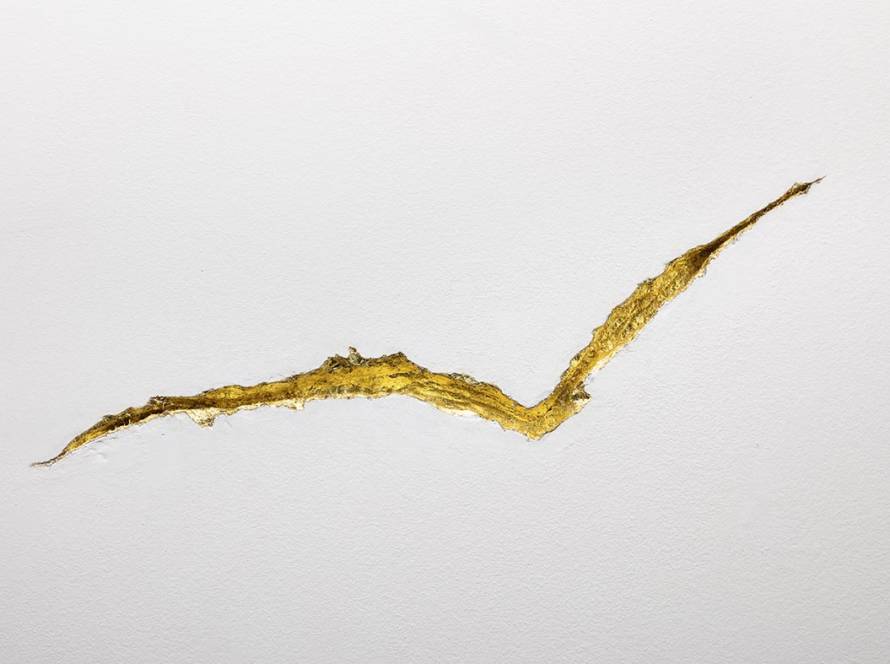
As in Andrea Francolino’s work about cracks, as bearers of numerous meanings, (which we will soon see here in an article-interview)
opportunity, loneliness, social revolution, confinement, distancing
Trust in the next or total lack of it, for the invisible enemy of asymptomaticity.
- opportunity, loneliness, social revolution, confinement, distancing
- Trust or total lack of it, for the invisible enemy of asymptomaticity
Artist Nico Vascellari, created a performance that had not been seen for some time, precisely on the theme of trust. By creating the hashtag #DOOU (Do you Trust me) and repeating the phrase “I trusted you” for 24 hours.
- Illness, health, medicine, historical pandemic, human fragility, recklessness, human selfishness, globality, absence of boundaries, lack of solidarity, sudden generosity.
- Popular closing, united countries also if distant, brotherood
Francesco Vezzoli and his beautiful Vanity Fair cover with the “wounded” tricolor: a tribute to Lucio Fontana’s cut, for the creation of spatiality and the reduction of the classic use of the canvas. Incarnation of a nation affected in health, in the economy, but also in the distrust of other countries.

- Physical distancing, virtual proximity, remote work, remote love, parents suddenly forced to be with their children 24 hours a day
The highly appraised artist Damien Hirst uses his popularity in creating a rather simple work, with a visual impact and easy recognition. A heart (“Butterfly Heart“) or a rainbow with the colors of peace and butterfly wings (“Help the Hungry”) to be downloaded for free from the web as a work of meta-art, to feel part of the community of those who support the cause. The originals, however, have been and will be sold in a limited edition to donate the proceeds to English hospitals.

Furthermore, many artists have been contacted to share the experience of quarantine as an event that brings artistic reflections, thoughts on life and its transience. But above all on all those things that we took for granted and that were suddenly taken away from us, labeled as potentially dangerous.
- Phase, resilience, brave, imminence, sublimation
Words that previously were used very little or in too different contexts: now used to describe the daily condition.
These same words were used by the French sculptress Manon Nicolay, to create material installations, inspired by these same terms. Hard, broken, rough materials with graceful movements, which seek balance on themselves, inspire a movement that would like to be done but is held back by something heavier.
We could going on for so many pages…
Concepts that emerge from this crisis are infinite, they branch out through everyday life, boredom, creativity and artistic vision. Works and exhibitions have been created for years. The history and art history books will have to create an artistic movement only for this 2020.
Before I conclude, I want to mention an important character who, like our Modigliani, Munch and Schiele, Hering was the first person protagonist of the disease. And it is still among us, so it represents a very precious testimony for the relationship between Virus and Art. Covid and Contemporary Art, to be correct
Michelangelo Pistoletto, 86 years old and healed by Covid. A versatile artist and bulwark of Arte Povera (Poor Art) movement, but also the creator of the “Third Heaven” project in which actions, artistic and otherwise, are devoted to creating a rediscovered and lasting balance between Nature and Human Being. Precisely, in the name of this philosophy, the artist speaks of his experience with one of the Terrible Two. He describes the virus as an hybrid of Science and Nature.
In other words, nature is always present and you have to deal with it, with the fact that these things happen when you come to an imbalance. It is like when, the disease leaves you without oxygen in the blood, there is a strong imbalance and it suffocates, the cells die. The artist was able, like many others, to reflect on the void that we do not notice because it is filled with the billions of stimuli that surround us. Those same stimuli which in turn constitute images of us (real, social, professional, friendly). But if these fail, our identity itself fails.

In my opinion (and here I swear to close) the experience of this flu has done more damage to our images. It revealed how unprepared we are if the surface of daily life cracks. We said that every disease somehow creates a “label” for those who contract it. Many would say that Covid-19 is equal to elderly or weak. I don’t know what label to give, I think only time will tell. This is a very diplomatic statement, maybe I could have the right word. But it remains a secret…
Art in Coronavirus times has a great common factor in its works: protection, coverage, the unknown factor of not knowing what we touch or who we meet anymore. Put a surface between us and the other. And the panic that this changes our existence, which forces us to limit our freedoms and our comforts, is more fearful than the Terrible Two.

The Terrible Two